
Readers often ask us and debate between themselves what is the best-looking factory cafe racer ever designed? Opinion divides folks fairly passionately when it comes to the aesthetic appeal of certain motorcycles, but it’s surprising how often disparate minds think alike. For instance, nearly everyone we communicate with believes Laverda’s sexy, parallel twin SFC750 to pretty much epitomize the European cafe racer style of the 1970s. Th stubby proportions, endurance racing-inspired half-fairing with twin headlights and unmistakable bright orange livery makes the SFC one of the most iconic performance bike designs ever. We weren’t exactly shocked to see the sole model on offer at the recent Mecum las Vegas Motorcycle auction sell for a whopping $63,000 and despite the scarcity of spare parts nr mechanics capable of working on such two-wheeled exotica, the buyer- a former Laverde factory team racer- claimed he planned to race the bike regardless.

Many cafe racer fans note the timeless lines and brisk performance of the Manx Norton singles as being the top factory cafe creation, and they make a good argument, especially considering how often that machine’s spare, sliver and black livery, humpbacked, five-gallon fuel tank and non-nonsense engineering continues to inspire motorcycle designers some 75 years later.
But one motorcycle that was on sale very briefly but still managed to leave a lasting impression was the Voxan Black Shadow. Created by the French design firm of the same name back in 2003, the 1,000cc water-cooled twin was derived from Voxan’s successful Cafe Racer model. That half-faired, modern machine supplied the minimal chassis (utilizing the V-twin engine as a stressed member) of the Black Magic, along with its top-shelf running gear and magnesium wheels. However, the Voxan team really went to town with the latter bike’s design brief, incorporating visual cues familiar to any dyed-in-the-leather fan of ton-up motorcycles. The black leather saddle swooped at its rear section with a hump mimicking that of the legendary matchless G50, while the fiberglass fuel cell was purely borrowed from the aforementioned Manx Norton of the ’50s and ’60s, right down to its brushed aluminum silver finish. Who wouldn’t be blown away by the cleverly-routed twin high-ride stainless steel exhausts and tiny radiator cooling the 102 horse powerplant?
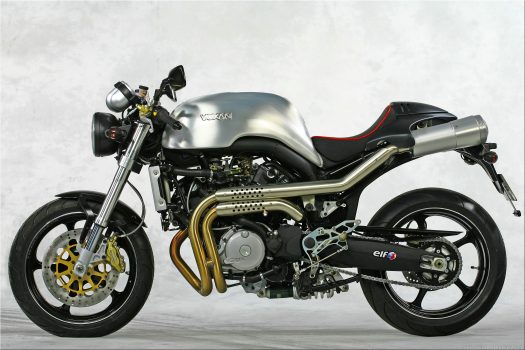
I was lucky enough to throw a leg over a demo model at the 2005 Isle of Man TT Races as Voxan were competing in the Senior TT with racer Fabrice Miguet. Eager to promote the small-production brand, Voxan allowed journalists to ride a street-legal Black Magic on the Mountain Course during non-racing hours and the torquey, long-legged twin proved every bit as exciting on the move as its aggressive looks promised. Voxan sold a fair number of Black Magic models in 2005 and ’06, promoting the firm to introduce and even mote stunning version for 2007, the Charade. This wildly-inspired retro roadster was basically a hot-rodded Black Magic wrapped in what is still considered the most lovely vintage-look fairing ever designed.
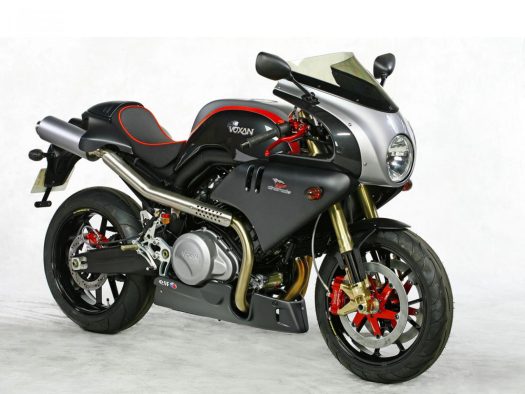
Though available only in the Uk and a few select European markets, the Voxan’s lack of access to North American riders made it all the more desirable. When Voxan went bankrupt a few years later, it only proved to cement the public’s lust for two motorcycles that clearly stand above all other factory cafe racers in recent years.


